
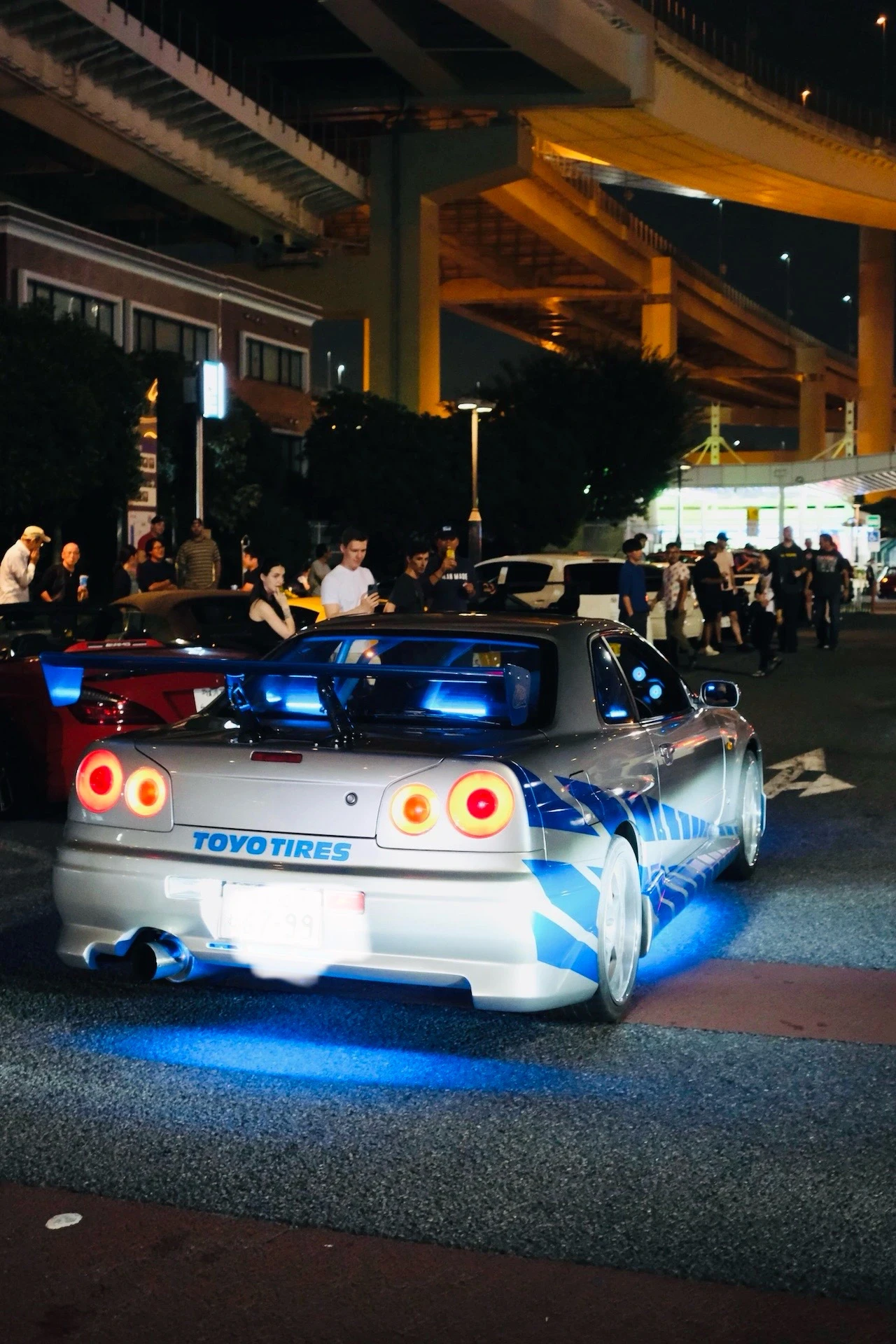
Tour Overview: Quick Summary
Before diving into the full guide, here are the essential facts. This is the tour that JDM fans and movie lovers worldwide call a once-in-a-lifetime experience — and everything you need to know is right here.
| Price Range | Approx. $100–$130 USD (see the official GetYourGuide listing) |
|---|---|
| Duration | Approx. 3–4 hours (night tour) |
| Advance Booking | Required — walk-ups are not accepted |
| Meeting Point | Tokyo / Yokohama area (exact details sent after booking) |
| Driving Licence | Not required — professional drivers operate all vehicles |
| Languages | English & Japanese |
| Group Size | Small groups (approx. 1–4 guests) |
| Highlights | Shuto Expressway Bayshore cruise + Daikoku PA car meeting |
| Best For | Movie fans, JDM enthusiasts, car photographers, night drive lovers |
* Pricing and tour details are subject to change. Always check the latest information on the official GetYourGuide booking page.
Fast & Furious and Daikoku PA — The Deep Connection
The Fast & Furious franchise, which launched in 2001, is the Hollywood series that brought street racing and custom car culture to a global audience. Of all its chapters, the third instalment — Fast & Furious: Tokyo Drift (2006) — holds a special place: it was the first film to introduce Japanese car culture, and particularly the art of drifting, to the international mainstream. To this day it commands a passionate fanbase around the world.
The "Other Tokyo" the Film Showed the World
Tokyo Drift constructed its universe from real Tokyo landmarks — Shibuya's scramble crossing, the layered flyovers of the Shuto Expressway — stitched together into a cinematic vision of the city. Protagonist Sean Boswell learns to drift in a Shibuya car park and sharpens his skills at local car meets, a fictional distillation of Tokyo's real street car scene. Shooting combined Los Angeles warehouse locations with actual Tokyo street footage, but it was Daikoku PA that the world's car fans fixed upon as the living, breathing place where the film's spirit truly existed.
After the film's release, overseas enthusiasts began making the journey to Yokohama's Daikoku PA specifically to find the world the movie had shown them. On weekend nights, rows of modified Silvias, Skylines, Lancer Evolutions, and Supras gather in exactly the way the film depicted — and many foreign visitors describe the experience as "more cinematic than the movie itself." The atmosphere is that good.
How Tokyo Drift Transformed Car Culture
Before 2006, drifting was deeply embedded in Japanese motorsport and street culture, but largely unknown outside enthusiast circles abroad. The film's release changed everything almost overnight. Viewership of D1 Grand Prix and Formula Drift soared. YouTube overflowed with amateur drift videos. Games like Need for Speed introduced drifting as a dedicated gameplay mode. The ripple effects were enormous.
The impact on JDM vehicle demand was even more striking. Cars that appeared in the film — the Mazda RX-7, Nissan 350Z, Mitsubishi Lancer Evolution, and Subaru Impreza WRX — saw prices spike dramatically in the North American, European, and Australian tuner markets after the film's release. The term "JDM" itself became a globally understood shorthand for the unique quality and character of Japanese domestic-market car culture.
Choosing Tokyo as the setting was not simply a pursuit of exotic atmosphere. Japan's modified car culture — the techniques refined through decades of motorsport and street driving, the obsessive mechanical refinement, the wildly individual custom aesthetics — all of it was broadcast to the world through Tokyo Drift, and the world responded.
What Is Daikoku PA? — The Complete Breakdown
Daikoku PA (Daikoku Parking Area) sits on the Shuto Expressway Bayshore Route in Tsurumi Ward, Yokohama, Kanagawa Prefecture — right alongside the industrial reclaimed land of Daikoku Futo (Daikoku Wharf). Surrounded on three sides by sea and working port, with container cranes glowing in the distance, the location has an otherworldly quality that feels like a film set even before a single car arrives.
It functions as a standard expressway service area — convenience store, toilets, petrol station — but what turned Daikoku PA into a legend is its sheer scale and geography. The expansive car park can organically accommodate hundreds of vehicles for a single night, and its location near a major junction where several Shuto Expressway routes converge makes it the natural gravitational centre for car enthusiasts from Yokohama, Kawasaki, and Tokyo alike.
The History of Daikoku PA: How It Became a Car Culture Mecca
Daikoku PA began attracting automotive enthusiasts in the late 1980s and through the 1990s. During Japan's bubble economy, demand for high-performance sports cars surged, and a succession of iconic domestic machines hit the market — the Nissan Skyline GT-R (BNR32), the Honda NSX, the Toyota Supra (A80). Young owners of modified versions naturally gravitated toward Daikoku PA's wide-open expanse near Yokohama port as the ideal place to show off their builds.
The 1990s saw certain bosozoku groups in the mix, which attracted negative attention and police scrutiny. But from the 2000s onward, increased patrols and the natural maturation of the scene shifted the atmosphere firmly toward car show culture. Today Daikoku PA is a space where drift cars, VIP sedans, itasha, bosozoku-style builds, stance cars, classic JDM collectors, and motorcycle clubs all coexist — each subculture occupying its own corner of this uniquely Japanese universe.
The Car Categories You Will See at Daikoku PA
A single walk through Daikoku PA at night reveals virtually the entire spectrum of Japanese car modification culture. Here is a breakdown of the main styles.
1. Drift Cars
Rear-wheel-drive machines — modified or purpose-built — designed to intentionally break traction and slide through corners. Classic platforms include the Nissan Silvia (S13/S14/S15), Nissan 180SX, Toyota AE86 (the legendary Hachi-Roku), and Mazda RX-7. Suspensions run super-low with uprated dampers, engines are frequently swapped, and the exteriors give the game away immediately — roll cage bars visible through windows, wide-body fender flares, liveries that mean business. Drift car owners at Daikoku PA range from professional competitors to serious amateurs, and conversations about build specs and run footage are conducted with complete earnestness.
2. VIP Sedan (VIP Style)
Born in Japan in the 1980s, VIP style takes large luxury saloons — Toyota Crown, Nissan Cima, Toyota Century — and drops them to the absolute limits of ground clearance on massive-diameter wheels run at extreme negative camber angles. The style's origins are widely traced to the luxury car modification preferences of yakuza culture, but today's VIP scene is a fully compliant, legitimate custom movement with a sophisticated aesthetic all its own. A jet-black Crown sitting millimetres from the tarmac has a surreal, almost sculptural beauty that is uniquely Daikoku PA.
3. Itasha
The word itasha merges "itai" (painfully embarrassing) with "sha" (car) — a tongue-in-cheek description of cars wrapped head-to-toe in vinyl graphics depicting anime, manga, and video-game characters. Works ranging from Kantai Collection and THE iDOLM@STER to the latest seasonal anime are rendered across bonnets, doors, and roofs with a level of craft and financial investment — sometimes exceeding 1,000,000 yen — that reflects genuine collector pride. Rows of itasha parked together at Daikoku PA represent a fusion of otaku culture and car culture found absolutely nowhere else on earth.
4. Bosozoku Style
Originating in Japan's bosozoku motorcycle and car gang subculture of the 1970s and 1980s, bosozoku-style builds are defined by radical, function-indifferent modifications: exhaust pipes extended and turned skyward to absurd heights, front bumpers jutting impossibly far forward, body side skirts that sweep the ground dramatically. At today's Daikoku PA, an increasing number of owners consciously preserve and recreate this style as art — a cultural homage to the Showa-era car scene. Overseas collectors have taken notice, and genuine bosozoku-style classic cars now command serious prices on the international market.
5. Stance Style
European in origin but thoroughly absorbed and evolved by the Japanese scene, stance culture is built around extreme suspension drop and large-diameter wheels stretched with "pulled" tyres (tyres mounted wider than their recommended rim width). The philosophy — prioritising visual presence and static aesthetics over outright driving performance — generates debate, but at Daikoku PA it is accepted as a legitimate form of automotive art. Golf GTIs, WRXs, Civics, and more transformed into stance builds parked in formation make for a genuinely impressive sight.
How the Tour Works: A Step-by-Step Guide from Meet-up to Drop-off
Whether this is your first JDM night tour or you're a seasoned enthusiast, here's everything you need to know about how the evening unfolds.
STEP 1 / Meet-up & Boarding (approx. 15–20 min)
The meeting point is confirmed in your booking email. It will typically be a car park or landmark near a train station in central Tokyo or the Yokohama area — aim to arrive about 10 minutes before departure. After meeting your guide and checking out the JDM vehicle, you'll receive a safety briefing, buckle up, and you're off.
Use this time to ask your guide what's expected that night — what cars have been showing up recently, and what the weather and day of the week might mean for the atmosphere. The same Daikoku PA can feel completely different from one visit to the next.
STEP 2 / Shuto Expressway Bayshore Night Cruise (approx. 30–45 min)
The Shuto Expressway Bayshore Route runs from the Rainbow Bridge area out to Yokohama and Daikoku Futo, threading along Tokyo Bay with factory lights and their reflections on the water creating a cinematic landscape unlike anywhere else. Getting to experience the sweeping Shuto expressway corners in an actual JDM vehicle — the same roads romanticised in the Fast & Furious franchise — is one of the tour's standout thrills.
Your guide will narrate the industrial nightscape, explain the expressway's architecture, and give context on Daikoku Futo's port operations as you cruise. Press your phone's camera gently against the window in night mode and you'll capture surprisingly beautiful shots even at speed. Keep your seatbelt on at all times.
STEP 3 / Daikoku PA Arrival & Car Meeting (approx. 60–90 min)
Pulling into Daikoku PA, the sheer scale of the car park is the first thing that hits you. Even on a weekday night there are dozens of tuned machines; on a busy weekend night, hundreds. The mix of engine notes, exhaust pops, and the bass of car stereos creates an ambient soundtrack unlike anything you've encountered before.
The tour includes free-exploration time to wander at will and focus on whichever cars catch your eye. If you want to talk to an owner, your guide is there to bridge the language gap — so there's no need to feel held back. Just point at the car that's caught your attention.
Photography is generally open, but observe Daikoku PA's unspoken etiquette: never touch another person's car; always ask before photographing it ("May I take a photo?" works perfectly); and don't block thoroughfares by standing in one spot for extended periods. Follow these simple rules and you will almost always be welcomed with genuine warmth.
STEP 4 / Return Journey & Drop-off (approx. 30–45 min)
After the car meeting, you'll head back by the same route or an alternative, with the guide conversation continuing — deeper dives into the cars you just saw, the history of Japan's car culture, and whatever questions have been building up all night. You'll be dropped at the original meeting point or a nearby pre-agreed location, and the tour is complete.
Consider finishing the evening with dinner in Yokohama Minato Mirai or Chinatown — both are short distances away and make a perfect way to extend the atmosphere of a memorable night.
Comparing Tours on Drifting Tokyo — Which One Is Right for You?
Drifting Tokyo features several tours related to Daikoku PA. Here's a side-by-side comparison to help you choose the best fit.
| Tour | Focus | Duration | Best For |
|---|---|---|---|
| Daikoku PA Fast & Furious Tour (this page) | Film universe atmosphere + full Daikoku PA car meeting experience | 3–4 hours | Fast & Furious fans; first-time Daikoku PA visitors |
| JDM Night Run Daikoku | Ride in an EVO, WRX, or Skyline + Daikoku PA | 3–4 hours | Enthusiasts who want to ride a specific JDM model |
| Private Drift Lesson | Hands-on drifting — you behind the wheel | 1–2 hours | Anyone who wants to actually drive and develop their skills |
The Fast & Furious Tour is especially suited to first-time visitors and movie fans who want a panoramic view of Daikoku PA's car culture as a whole, rather than focusing on a single vehicle type. If you want to go deeper and get behind the wheel yourself, consider pairing this tour with a Private Drift Lesson.
Insider Tips from a Local: How to Get the Most Out of Daikoku PA
These are the real-world insights you won't find in any official brochure — from someone who has visited Daikoku PA many times over.
Tip 1: Saturday at 10 PM Is the Golden Hour
Daikoku PA is often assumed to be buzzing at any time of night — but the scale varies enormously by day and hour. The most consistently electric window is Saturday night between 9 PM and 11 PM, with the peak typically landing around 10 PM as cars converge from across the greater Tokyo area. After 1 AM the crowd begins to thin, so you'll also find Saturday owners more relaxed and conversational than on Friday nights, when many have work the next morning.
Tip 2: Overcast Nights Photograph Better Than Clear Ones
Counter-intuitively, a lightly overcast sky often produces more photogenic results than a clear night. Cloud cover diffuses and reflects the surrounding factory and port lighting, creating a soft, even ambient glow across the car park that eliminates harsh shadows. Smartphone night modes thrive in exactly these conditions. On a clear night with a bright moon, camera exposure algorithms can be pulled toward the sky and leave the car park underexposed.
Tip 3: Drift Cars Park Toward the Back
Daikoku PA's layout divides loosely into a general area near the entrance and a large expanse at the far end. The far section — especially around the far corners past the main building — is the traditional territory for drift cars and sports builds. VIP sedans and itasha tend to cluster nearer the entrance. Ask your guide before you start exploring: "Where are the drift cars tonight?" and you'll save yourself a lot of walking.
Tip 4: The Convenience Store Is the Social Hub
The 24-hour convenience store inside Daikoku PA is the social nerve centre of the entire gathering. Owners stand around with canned coffees and energy drinks, falling into animated conversations with strangers about their builds. An offhand "That blue Silvia — is that yours?" can open a door to a surprisingly deep exchange. Even without shared language, showing photos on your phone is a universal currency at Daikoku PA.
Tip 5: Don't Miss the Departure Convoy
Around 1–2 AM, when cars start leaving en masse, a fresh wave of photographic opportunity opens up. The moment an engine fires, headlights blaze, and the sound of exhaust systems echoing off the concrete is something only the departing hour delivers. Many tours end before this point, but if the timing allows, it's worth asking your guide if you can linger just a little longer.
Tip 6: Golden Week, Obon, and New Year Are Another Level
The extended national holidays — Golden Week (late April to early May), Obon (mid-August), and New Year (late December to early January) — bring Daikoku PA to its absolute peak. Owners travel up from across the country, rare cars appear that would never normally make the trip, and the overall energy ratchets up noticeably. Demand for weekend tour slots during these periods fills quickly — book well in advance.
Booking Guide: How to Get the Best Deal
Why Book Through GetYourGuide?
GetYourGuide is the most straightforward way to book a JDM tour to Daikoku PA, for three reasons. First, cancellation policies are clearly stated upfront, with many tours allowing free cancellation up to 24–48 hours before departure. Second, full support is available in English, Japanese, and a range of other languages. Third, a substantial volume of verified reviews gives you an honest gauge of tour quality before you commit. Booking through GetYourGuide is simpler, more secure, and more transparent than contacting tour operators directly.
Early Booking Can Save You Money
GetYourGuide occasionally runs limited-time early-bird deals and promotional discounts. More importantly, popular Friday and Saturday night slots regularly sell out one to two weeks ahead — so booking early isn't just about saving money, it's about securing your preferred date at all. Groups of two to four people often find that per-person costs are lower when booking together, so rope in friends or travel companions if you can.
Three Things to Check Before You Buy
Before purchasing, confirm the following: (1) Vehicle type — check whether the car you most want to experience (e.g., Skyline GT-R) is included in that specific tour. (2) Meeting point — confirm whether departure is from Tokyo or Yokohama and calculate travel time from your accommodation. (3) Start time — verify that the tour is scheduled to arrive at Daikoku PA during the prime window (roughly 9–11 PM). Tick all three boxes and you are set up for exactly the experience you are hoping for.
Expert Perspective: Daikoku PA and the Future of JDM Culture
The Fast & Furious Legacy and the Shifting JDM Market
JDM vehicles whose demand was turbocharged by the film franchise have continued to appreciate sharply through the 2020s. In particular, late-1990s-vintage models now eligible for import to the United States under the 25-year rule — R33 and R34 Skylines, Mitsubishi Lancer Evolution IV through VI — are fetching prices equivalent to several hundred thousand dollars in the North American market due to their popularity and scarcity. The "ordinary modified car" parked at Daikoku PA tonight may well be a coveted collector's piece that commands extraordinary sums abroad — a fact that surprises many Japanese enthusiasts.
The Future of Daikoku PA: Preservation vs. Regulation
Daikoku PA has in recent years become the subject of ongoing debate around late-night use restrictions and noise complaints. Some long-time regulars feel the environment has tightened compared to earlier eras, and certain groups have attracted criticism for inconsiderate behaviour. At the same time, within the context of Yokohama and Kanagawa Prefecture's inbound tourism strategy, there is a growing movement to treat Daikoku PA's car culture as a cultural asset worth protecting. As a tour visitor, respecting the site's unwritten rules is the single most meaningful contribution you can make to keeping this scene alive.
Daikoku PA in the Social Media Age: Instagram vs. the Real Thing
Daikoku PA is extensively documented on Instagram and YouTube, and you can do a great deal of research before you arrive. But nothing on a screen prepares you for being there. The physical vibration of a V8 turbo idling three metres away. The specific smell of hot rubber, oil, and sea air. The quiet pride in a builder's eyes as they watch strangers take in their work. These are things no device can replicate. If you've been "knowing about" Daikoku PA through social media, it's time to start "experiencing" it in person.
Frequently Asked Questions
Answers to the questions we hear most often about this tour.