
Tour at a Glance: Quick Summary
Before diving into the details, here are the essential facts about the Tokyo JDM Tour: Daikoku PA — everything you need to know before booking.
| Tour Name | Tokyo JDM Tour: Daikoku PA |
|---|---|
| Price Range | Approx. $100–$150 USD (see GetYourGuide official platform for current pricing) |
| Duration | Approx. 3–4 hours (night tour) |
| Advance Booking | Required — walk-up participation is not available |
| Meeting Point | Tokyo or Yokohama area (details provided after booking) |
| Driver's Licence | Not required — professional driver provided |
| Tour Languages | English and Japanese |
| Group Size | Small group (approx. 1–4 guests) |
| Main Destination | Daikoku PA (Tsurumi Ward, Yokohama, Kanagawa — Shuto Expressway Bayshore Route) |
| Cars You'll See | Skyline GTR, RX-7, Supra, EVO, WRX, NSX and more |
* Pricing and tour content are subject to change. Always check the GetYourGuide booking page for the most up-to-date information.
What Will You Experience on This Tour?
The Heart of the Tokyo JDM Tour: Daikoku PA
The "Tokyo JDM Tour: Daikoku PA" is a night-run tour centered on Daikoku Parking Area — the undisputed front line of Japan's tuned car culture. This is nothing like a tour bus or a sightseeing package. It's a raw, authentic JDM culture experience.
You ride in a genuine JDM vehicle — EVO, WRX, or Skyline — with a professional driver at the wheel, taking the Shuto Expressway Bayshore Route through Yokohama's industrial nightscape to Daikoku PA. And waiting for you there is a "wild car meet": Skyline GTRs, Mazda RX-7s, Toyota Supras, and hundreds of tuned machines gathering entirely under their own steam.
Why This Tour Is Different
Daikoku PA sits alongside the Shuto Expressway Bayshore Route and is effectively unreachable by public transport. Technically you could arrive by taxi or rental car, but showing up without context for JDM culture — or any connections to the local community — risks leaving with nothing more than a surface-level tourist experience.
With this tour, a guide walks you through the JDM culture backstory and acts as a bridge between you and the car owners. The language barrier dissolves, and you end up right at the centre of the real Daikoku PA community. That's the single biggest reason to join a tour.
How a Typical Tour Runs
- Meet-up (around 7:00–8:00 PM) — Meet your guide and driver at the designated point in Tokyo or Yokohama. Vehicle walk-around, safety briefing, and JDM culture introduction.
- Night Run Departure — Jump into a real JDM car and hit the Shuto Expressway Bayshore Route. Take in Yokohama Port's industrial nightscape and the bay area lights en route to Daikoku PA (approx. 15–25 minutes).
- Daikoku PA Exploration & Car Meet (1–2 hours) — Wander freely through the parking area. Chat with Skyline GTR and RX-7 owners, shoot photos to your heart's content. Your guide handles introductions and vehicle explanations throughout.
- Return Night Run & Farewell — Back on the expressway for the return leg, then dropped at the meeting point. Detours to nearby nightscape spots can sometimes be arranged on request.
Daikoku PA is what I'd call a living textbook of tuned cars. The sound of a Skyline GTR's RB engine in the flesh, the unique rotary idle of an RX-7, that split-second sensation when a Supra's 2JZ hits boost — none of that comes through in videos or photos. There's a sound, a smell, a heat to being there in person that you simply can't replicate. This tour is your passport to that place. — Author, 10+ years covering JDM culture
The Tuned Cars of Daikoku PA: A Complete Guide
The greatest draw of Daikoku PA is an unparalleled concentration of JDM machinery found nowhere else on earth. Here's a deep dive into the key models and what to look out for when you see them in person.
Nissan Skyline GT-R (R32 / R33 / R34 / R35)
No conversation about Daikoku PA is complete without the Nissan Skyline GT-R. From the R32 GT-R (1989) — nicknamed "Godzilla" — through the R33, R34, and the current R35, the Skyline GTR has stood at the absolute apex of Japanese JDM culture for over three decades.
The R34 GT-R (BNR34) is the most coveted of all. After Brian O'Conner's iconic silver R34 appeared in The Fast and the Furious 2 (2003), it became a global legend. Today, clean examples trade for ¥10–20 million or more on the collector market.
- R32 GT-R: RB26DETT inline-6 twin-turbo (280 hp — the gentleman's agreement limit). Went 29 for 29 in Group A racing. Now a rare sight at Daikoku PA — all the more special when one shows up.
- R33 GT-R: Larger and heavier than the R32, yet it held the fastest 0–400 m time in GT-R history when new. Long dismissed as the "fat one," its reputation has since been fully rehabilitated.
- R34 GT-R: The definitive GT-R. Multi-Function Display (MFD), carbon rear spoiler on V-Spec models. The most valuable GT-R on today's collector market.
- R35 GT-R: In production since 2007, powered by the all-new VR38DETT (485–600+ hp depending on trim). A hugely popular tuning platform — 1,000 hp R35 builds occasionally roll into Daikoku PA.
When you approach a GTR owner at Daikoku PA, specific questions land well: "What makes the NISMO version different?" or "How high does the speedo go on the R34?" Owners are proud of their cars' specs and love talking about them.
Mazda RX-7 (FC3S / FD3S)
The Mazda RX-7 occupies a category of its own as the world's only mass-produced sports car ever powered by a Wankel rotary engine. Instead of pistons, a triangular rotor spins to generate power — delivering a uniquely lightweight, high-revving character unlike anything else on four wheels.
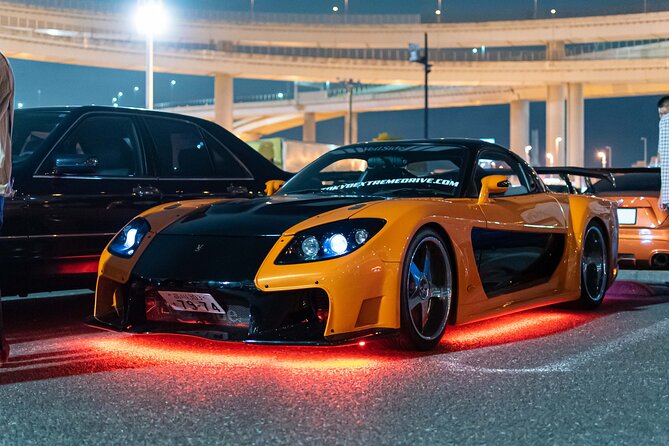
The most celebrated RX-7 is the FD3S (1991–2002): rear-wheel drive only, a sequential twin-turbo 13B-REW (255 hp), and a near-perfect 50:50 front-to-rear weight distribution. It's the purist's sports car taken to its logical conclusion.
- FC3S (1985–1991): 12A or 13B engine. Softer, more graceful styling than the FD. Slightly larger than the first-generation RX-7 (SA22C) but light and beautifully balanced.
- FD3S (1991–2002): 13B-REW sequential twin-turbo, 654 cc per rotor × 2. At 255 hp the power feels linear and addictive. Ryosuke Takahashi's FD in Initial D introduced an entire generation worldwide to JDM culture.
- Tuning examples: Single-turbo conversions and bridgeport modifications (enlarging the intake/exhaust ports in the engine housing) can push output beyond 500 hp. The sound at high revs becomes something truly savage.
If you spot an RX-7 at Daikoku PA with the bonnet raised, seize the moment — the compact rotary unit sitting in the engine bay is something every car fan should see at least once. Don't be surprised if the spare wheel has been removed in the pursuit of weight reduction.
Toyota Supra (A70 / A80)
The Toyota Supra (JZA80) is worshipped worldwide as the ultimate tuning platform, courtesy of its 2JZ-GTE inline-6 twin-turbo engine. Stock output was 280 hp (the gentleman's agreement cap), but the block's legendary strength means 1,000 hp and even 1,500 hp builds are not unusual. Paul Walker's orange A80 Supra in The Fast and the Furious (2001) cemented its status as the ultimate JDM icon.
- A70 Supra (1986–1993): 7M-GE/7M-GTE powered. Strong straight-six torque and the definitive 1980s JDM visual aesthetic.
- A80 Supra (1993–2002): 2JZ-GTE 3.0-litre twin-turbo. The legend that "2JZs don't break" is essentially true — strengthen the internals and the block can handle well over three times stock power.
- New GR Supra (A90): Co-developed with BMW using the B58 engine. High-performing by any measure, but many old-school JDM fans regard it as a different car entirely.
Mitsubishi Lancer Evolution (EVO IV–X)
Born from Mitsubishi's World Rally Championship programme, the Lancer Evolution ran for ten generations — from EVO I (1992) to the final EVO X (2015) — and evolved relentlessly with each one. The 4G63 engine (EVO IX and earlier) is among the world's most capable turbocharged platforms; 600 hp and 800 hp+ builds are not an uncommon sight at Daikoku PA.
- EVO IV–VI (1996–2001): The maturing phase of the 4G63. Active Yaw Control (AYC) reaching full refinement. The EVO VI Tommi Mäkinen Edition is particularly rare.
- EVO VII–IX (2001–2007): Race-proven in touring car championships worldwide. Widely regarded as the balanced, fully realized final form — still highly sought-after on the used market.
- EVO X (2007–2015): Modernized with an SST (Sport Shift Transmission) dual-clutch gearbox. Engine changed to the 4B11.
Subaru Impreza WRX STI (GC8 / GDB / GRB)
The eternal rival to the EVO, the Subaru Impreza WRX STI is driven by a flat-four turbocharged "boxer" engine whose distinctive burble — the "boxer sound" — has inspired a worldwide following. Symmetrical AWD (a genuinely symmetrical drivetrain layout) gives it exceptional low-centre-of-gravity stability, and its composure in rain or on changing road surfaces sets it apart from most JDM sports cars.
Honda NSX (NA1 / NA2)
The Honda NSX (1990–2005) was conceived as a supercar that any driver could live with day-to-day. It's also the car that three-time F1 World Champion Ayrton Senna had a direct hand in developing. The C30A V6 naturally aspirated engine is a joy to rev, and if you catch one being exercised at Daikoku PA, consider it a lucky night.
- NA1 (1990–1997): C30A 3.0-litre V6, 270 hp. Lightweight all-aluminium monocoque construction.
- NA2 (1997–2005): Enlarged to a C32B 3.2-litre V6 with 290 hp. The six-speed manual's shift action is still praised to this day.
Honda Civic Type R (EK9 / EP3 / FD2)
The Honda Civic Type R has long held the title of "fastest front-wheel-drive car." The B16B (EK9) and K20A (EP3/FD2) engines are textbook high-revving naturally aspirated units that scream all the way to 8,000–9,000 rpm in a way nothing else quite matches. You can't attack corners at Daikoku PA, but pop the bonnet and the engine's presence speaks for itself.
Beyond the headline acts, you'll also encounter Nissan Fairlady Z (S30, Z32, Z34), Toyota MR2 (SW20), Mazda RX-8, Honda S2000 (AP1), Mitsubishi GTO, and even American muscle and European tuned cars. On a big night with 200–400+ cars filling the lot, Daikoku PA is arguably the world's greatest spontaneous car show.
Daikoku PA Culture Deep Dive: Why This Place Is a Global Mecca
The History and Origins of Daikoku PA
Daikoku PA's transformation into a "holy ground of tuned cars" dates back to the early 1990s. As the Shuto Expressway Bayshore Route was developed and access improved, the vast parking area set within Yokohama's industrial port district began attracting local racers and car enthusiasts organically — showing up spontaneously in the small hours.
What started as a gathering of local Yokohama and Kawasaki drivers expanded as the internet spread the word. JDM fans from across Japan started making the pilgrimage, and then overseas YouTubers and automotive media began filming there, giving Daikoku PA global recognition. Today visitors travel from the UK, USA, Australia, South Korea, China and beyond to see it for themselves.
The Layout of Daikoku PA: Where to Find What
Daikoku PA is centred on a large parking lot adjacent to the Daikoku Futo interchange on the Shuto Expressway Bayshore Route. A central building (toilets, vending machines, convenience store) is ringed by an oval expanse of parking spaces that serves as the "venue."
While unofficial, distinct zones tend to form organically:
- GTR & Sports Car Zone — Immaculately polished GTRs and Supras tend to claim the prominent spots near the entrance.
- Wild Build Zone — Full aero, wide-body tuned cars pack in here. Expect front lips that hover millimetres above the ground.
- VIP Car Zone — Sedans like Crown and Cima slammed on air suspension to the absolute limit. A distinct aesthetic world of its own.
- International Zone — A corner where Corvettes, Mustangs and various European builds sometimes mix with the JDM machinery.
The Unwritten Rules of the Car Meet
There's no official rulebook for the Daikoku PA car meet, but long-standing customs are observed. Here's what every tour participant should know.
- Keep the revving in check — Excessive idling or needless revving near residential areas at night is considered antisocial behaviour. Kanagawa Prefectural Police patrol the area regularly.
- Never touch someone else's car — No matter how beautiful a GTR looks, you do not touch it without the owner's permission. "May I?" goes a long way.
- Take your rubbish with you — The car community here has a strong shared sense of responsibility for keeping the space. Littering reflects badly on everyone, and the culture of self-policing is strict.
- No demo runs or burnouts on site — Dangerous driving inside Daikoku PA is strictly forbidden. The true culture here is about showing your car, not hooning it. Daikoku PA is not a circuit.
Daikoku PA and Pop Culture: Film, Anime and Beyond
Daikoku PA has left a deep mark on fictional culture. The Fast and the Furious franchise introduced Japan's night street car culture to a global audience, making Daikoku-style late-night car meet culture an object of worldwide fascination.
In anime and manga, Initial D, Wangan Midnight and Car Graphic TV deified the Skyline GTR, RX-7 and Supra. In particular, Ryosuke Takahashi's Mazda FD3S RX-7 and Nakazato's R32 Skyline GT-R in Initial D provided an entry point into JDM culture for younger fans across the globe.
Daikoku PA Today: The Current Reality
The environment around Daikoku PA has shifted gradually since the late 2010s. Greater visibility through social media brought more foreign visitors, and in response some of the long-standing local regulars now leave earlier than they used to. Stricter noise enforcement means the freewheeling atmosphere of the early days has softened somewhat.
But the core car meet culture remains very much alive. The community of respectful car fans who come to enjoy it still pulses through the venue on weekend nights. When you visit, bring the same mindset — observe the etiquette, appreciate the culture, and help ensure it continues for future generations.
Understanding Tuning Culture: Body Kits, Engine Swaps & Wide Bodies
A working knowledge of Japan's tuning culture adds enormous depth to your Daikoku PA experience. Here's a breakdown of the key custom styles and what they mean.
Aero & Body Kits: The Aesthetics and Function of Styling
In Japanese tuning culture, a body kit is far more than a visual dress-up — it's the pursuit of aesthetics and aerodynamic function combined. Full aero setups combining front bumper, side skirts, rear bumper and rear wing transform a stock car completely, and you'll encounter dozens of them at Daikoku PA.
- Veilside: Known worldwide for the RX-7 body kit from The Fast and the Furious. Their boldly rounded, aggressive designs occasionally appear at Daikoku PA.
- RE Amemiya: The most respected specialist tuner for the Mazda RX-7, covering aero, engines and suspension. Often called "the RX-7 bible."
- BN Sports / Bomex / Shine Auto: Known for volume-style body kits for GTR and EVO. Several were ahead of their time in embracing the wide-body look.
- NISMO / TRD / Mugen: The official motorsport arms of Nissan, Toyota and Honda respectively. Trusted for factory-backed performance upgrades with a factory-adjacent aesthetic.
Engine Swaps: The World of Power and Belief
An "engine swap" means removing a car's factory engine and installing a different one. In Japan's tuning world, certain engines have acquired near-religious status — to the point where people buy a car specifically as a host for a particular engine.
- 2JZ-GTE (Supra): The legendary iron block that "never breaks." 2JZ swaps are performed all over the world into Civics, AE86 Levins, Silvias, 180SXs and more. There are documented cases of a stock block holding together beyond 1,000 hp.
- RB26DETT (GT-R): Called the "god engine." Widely stroked to RB28 or RB30 displacement; 800–1,000+ hp builds exist.
- SR20DET (Silvia): The go-to turbocharged engine for the 180SX and Silvia S13/S14. The drift community's engine of choice worldwide.
- 13B-REW (RX-7): Rotary swaps, single-turbo conversions and bridgeport work. Demanding to own and maintain — the domain of owners who truly know their car.
Wide Body: The Big Fender Conversion
Wide-body builds widen the car's overall stance and push the front and rear fenders outward dramatically to accommodate wider tyres and wheels. Daikoku PA gives you plenty of chances to see impressive wide-body builds up close.
- Overfenders (clinch-type): Sheet metal extensions added to the original fenders. Easier to remove than welded alternatives.
- FRP/carbon fender swap: Full fender replacement. Allows a larger flare and reduces weight simultaneously.
- RocketBunny / Pandem: Japan's most globally influential wide-body kit brand. Designed by Kei Miura of TRA Kyoto — his work is imitated worldwide.
Coilovers & Air Suspension: The Obsession with Ride Height
The first thing you'll notice walking through Daikoku PA is the parade of cars sitting millimetres off the tarmac. Japan's tuning culture has long held a deep reverence for the low stance — locally known as "shoktan" (short for shachotan, meaning "lowered vehicle height") — and that culture lives on today.
- Coilovers: Adjustable suspension combining spring and shock absorber in one unit. Japanese brands Tein, HKS, Cusco and Blitz command massive respect.
- Air suspension: An air-pressure system that adjusts ride height in real time — raised for driving, slammed to the floor when parked or on display. Particularly common in VIP-style sedan builds.
- Stance builds: Lowered with extreme negative camber — wheels tilted dramatically outward. Pure visual impact over practicality. Its own subculture.
Insider Tips for Daikoku PA: Timing, Photography & Talking to Owners
The Golden Rule of Arrival Timing
When you arrive at Daikoku PA shapes the entire experience. Too early and the car count is thin. Too late and the lot is so packed you can't move freely for photography. The sweet spot is 9:00–9:30 PM.
At that window, the key cars have arrived, but there's still breathing room to move around and shoot. Tours are built around arriving during this window, but if you want even better access, ask your guide about departing a little earlier — they'll often accommodate you.
Practical Night Photography Tips for Smartphones
Daikoku PA is a night venue with limited ambient lighting, so low-light shooting is the norm. But you don't need a camera — today's flagship smartphones are more than capable.
- Night Mode on: iPhone 14 and later, Pixel 8 and later, Galaxy S24 and later all handle the darkness brilliantly with Night Mode. Keep the phone steady to avoid blur.
- Use headlights as backlight: Parked cars with headlights on create natural backlighting that makes your subject pop. Aim for light coming in from the side rather than shooting directly into it.
- Low-angle shots: Get close to the ground and shoot upward at the wheels, exhausts and aero. Dramatic and powerful. Ground-reflected light adds to the effect.
- Mirror reflections: After rain, puddles and wet tarmac act as mirrors. A forecast of "light rain then clearing" is actually a good sign for photography.
- Video for engine sounds: The RB engine note of a GTR and the rotary idle of an RX-7 are best captured in video. Shoot both stills and clips — you'll thank yourself later.
Phrases for Talking to Car Owners
One of Daikoku PA's greatest joys is speaking directly with owners of cars you'd never normally get near. Enthusiasm crosses any language barrier.
- "This is sick!" / "Unreal build!" — Genuine enthusiasm is universally understood. In Japanese: "Kakkoii desu ne!" (かっこいいですね!)
- "May I take a photo?" — In Japanese: "Shashin ii desu ka?" (写真いいですか?). Almost always gets a smile and a yes.
- "How many horsepower?" — Japanese tuning owners love talking specs. Ask about power output and prepare for a long, enthusiastic answer.
- "Is that an EVO / GTR / RX-7?" — Naming the car correctly immediately signals you know what you're looking at. Your guide will help bridge the conversation from there.
What to Pack: Daikoku PA Night Run Checklist
- Fully charged smartphone — A dead battery will ruin your night. Bring a portable power bank.
- Thin down jacket or windbreaker — The Yokohama bayfront is breezy year-round and cold at night. Essential from October through April.
- Comfortable trainers / sneakers — You'll walk 1–2 km across the lot. Avoid heels or sandals.
- Cash (¥1,000–¥2,000 approx.) — Vending machines in the PA may be cash-only.
- Compact mirrorless camera (if you have one) — Sony α6000 series, Fujifilm X-S10 and similar cameras handle night shooting well. A small tabletop tripod is more useful than a full-size one.
Ticket Comparison: Which Plan Is Right for You?
The tour on GetYourGuide may offer multiple options depending on your budget and style of participation. Use the comparison below to choose the best fit.
| Feature | Standard Plan | Premium / Combo Plan |
|---|---|---|
| Daikoku PA Visit | ✓ Included | ✓ Included |
| Ride Vehicle | EVO / WRX / Skyline (assigned on the day) | Vehicle choice or premium model |
| Night Run Route | Daikoku PA return (standard route) | Extended route with multiple stops |
| English Guide Support | ✓ Included | ✓ Included |
| Time at Daikoku PA | Approx. 60–90 minutes | Up to 120+ minutes (plan dependent) |
| Price Range | $100–$120 | $130–$160+ |
| Best For | First-timers, value-seekers, travellers with limited time | Specific car preferences, repeat visitors, late-night enthusiasts |
* The above is for reference only. Confirm actual options and pricing on the GetYourGuide booking page.
Which Plan for a First Visit?
If this is your first Daikoku PA JDM tour, the Standard Plan is all you need. The real value of this experience isn't the vehicle you arrive in — it's the space itself. Seeing a Skyline GTR, RX-7 or Supra with your own eyes, hearing the engine note live, and actually talking with an owner — that is the essential experience.
Once you've been once and become a repeat visitor, the natural progression is to think "next time I want to arrive in a specific car" or "I want more time there" — which is when the Premium Plan starts to make sense.
Complete Timing Guide: Best Season, Day & Hour for Daikoku PA
The Best Days of the Week
The scale of the Daikoku PA car meet varies significantly by day of the week. Here's a breakdown based on years of on-the-ground observation.
- Friday night (9:00 PM–1:00 AM): With the weekend ahead, many owners stay late. Lots of local regulars, giving Friday an "at home" feel that's more relaxed than Saturday.
- Saturday night (9:00 PM–2:00 AM): The "golden night" — the single biggest gathering of the week. Long-distance visitors arrive in greater numbers, maximizing the diversity of cars on show.
- Sunday night (8:00 PM–midnight): People tend to head home earlier with work the next day, but even so the scale is many times that of a weeknight. Convenient for weekend travellers.
- Weekdays (Mon–Thu): Car meets are rare. Only the most dedicated local regulars turn up — but that can actually mean more relaxed, unhurried conversations.
How the Night Evolves: What to Expect Hour by Hour
- 7:00–8:00 PM: Early arrivals begin parking. Your last chance for wide-angle shots of the whole lot before it fills.
- 8:00–9:00 PM: Numbers building, engine notes and exhaust sounds starting to echo. Still spacious enough to study each car at your leisure.
- 9:00–11:00 PM: Peak time. Hundreds of cars pack the lot; the energy and buzz are at their highest. Best window for both photography and talking to owners.
- 11:00 PM–1:00 AM: A gradual thinning as people leave, while the "late-night regulars" settle in. Good for time-lapse and long-exposure photography.
- 1:00–3:00 AM: Only the true night owls remain. Deeper conversations are possible with the hardened regulars. Tours typically wrap up before this point.
Best Seasons of the Year
Daikoku PA is open 24 hours year-round, but some months are considerably more pleasant than others.
- May–June (pre-rainy season): Temperatures 15–25°C and comfortable at night. Easy on both visitors and engines. Probably the best all-round time of year.
- September–October (clear autumn nights): The summer heat has faded and the sky is clear. Halloween weekend occasionally brings creatively themed custom builds.
- November–December: Night temperatures can drop to 5–10°C, but the view of Tokyo Bay at night is at its most beautiful. Wrap up warm and the photography is outstanding.
- Mid-summer (July–August): Hot and humid — tropical nights — which puts some owners off attending to protect their cars' cooling systems. That said, weekends still draw a decent crowd.
- Winter (January–February): The coldest months see the smallest turnout. On the plus side, the reduced crowds mean more time with each car.
Special Events & Themed Nights
No official car shows are held at Daikoku PA, but unofficial "themed nights" do emerge organically — a night where GTRs dominate, or where a specific tuning shop rallies its customers through private social media posts. Your tour guide will usually be plugged into this kind of intelligence; after booking, it's worth asking "what's been happening at Daikoku PA recently?" for the most current read.
Save Smart: Group Rates, Early Bird Deals & Booking Tips
Bring a Group to Lower the Per-Person Cost
Because the Tokyo JDM Tour operates in small groups, the per-person cost can vary with group size. Plans with three or four participants often work out better value than booking for two. If you're coming with friends or family, always check whether a group rate applies.
Book Early for the Best Price
- Some operators offer early-bird discounts for bookings made 2–4 weeks in advance.
- High-demand slots — especially Saturday nights — are subject to dynamic pricing and can be more expensive. Friday or Sunday night departures sometimes cost less for the same tour.
- GetYourGuide occasionally distributes limited-time promo codes. It's worth checking their official social media channels and newsletter before booking.
Make the Most of Free Cancellation Policies
Most tours guarantee free cancellation up to 24–48 hours before departure. A useful strategy is to book tentatively while your itinerary is still being finalized, then confirm or cancel once plans are set. Cancellation policies vary between tours — always read the fine print on the booking page.
Optimize Total Cost with a Combo Booking
Booking the Daikoku PA tour alongside a drift experience lesson (private drifting lesson) with the same operator may unlock a combined discount. Operators sometimes offer repeat-visitor discounts when you book multiple JDM tours during the same trip — ask your guide when making your first reservation.
Earn a Discount on Your Next Tour by Leaving a Review
GetYourGuide runs periodic campaigns rewarding honest post-tour reviews with points or coupons. If credits accumulate toward a future booking, leaving a review after your tour could help fund your next JDM adventure.
Expert Insights: Reflections from 10+ Years Covering JDM Culture
What Has Changed at Daikoku PA — and What Hasn't
Compared to the early 2010s, the atmosphere at Daikoku PA has genuinely shifted. Global recognition via social media has brought a steady flow of international visitors, and some of the long-standing local regulars now leave earlier than they once did. Tighter noise regulations have taken the edge off the anything-goes energy of the early days.
But the core remains untouched. On a weekend night beneath Yokohama Bay's sky, a Skyline GTR and an RX-7 and a Supra are still lined up side by side — and standing in front of that scene, you feel the same density of Japanese car culture that Daikoku PA has always had. If anything, attending with a genuine respect for the etiquette now opens doors to deeper interactions than ever before.
The Philosophical Divide: RX-7 Owners vs GTR Owners
After years of spending time at Daikoku PA, a pattern emerges: RX-7 owners and GTR owners have fundamentally different relationships with their cars.
Most RX-7 owners are in love with lightness and purity. They chose the rotary knowing full well how temperamental it can be — and precisely because of that, they find it endearing. There's a "difficult child, therefore more beloved" emotional logic to it. GTR owners lean the other way: the drive is to take the most comprehensively equipped car and bring it to the highest possible state of perfection. Both attitudes represent the richness of Japanese car culture in their own way.
The "Curse" of the R34 Skyline GTR
There was a night at Daikoku PA when I got into a long conversation with the owner of an R34 GT-R V-Spec. He told me, with a rueful smile, that he'd stopped being able to drive it properly. The value had risen to the point where a serious accident wouldn't be covered by insurance. He was too nervous to take it on track. Too nervous to push it on public roads either. So he polishes it, brings it to Daikoku PA, and stands there looking at it.
It sounds like a collector's curse — but the way that meticulously polished R34 held itself in the Daikoku PA night, it had an aura entirely separate from any new supercar. That's the depth of Daikoku PA that no video can convey.
Final Advice on Choosing Your Tour
If you've read this far, you already have a genuine interest in Daikoku PA and JDM culture. If you're still on the fence about going — go. Daikoku PA is the kind of place that turns first-time visitors into regulars.
For a first visit, the Standard Plan is more than enough. What matters isn't what car you ride in — it's who you go with, what you see, and what you feel. The moment you hear a GTR's idle for the first time in person, every explanation becomes unnecessary.
Frequently Asked Questions (FAQ)
Common questions from people considering the Tokyo JDM Tour to Daikoku PA, answered before you book.